
AI development challenges in OOP
Artificial intelligence (AI) has come a long way in recent years, and as we continue to explore its vast potential, one thing is becoming increasingly clear: AI development brings with it a unique set of challenges. In the world of object-oriented programming (OOP), these challenges can be particularly complex. From navigating the intricacies of machine learning algorithms to grappling with issues surrounding data privacy and security, there's no shortage of obstacles for developers looking to leverage AI in their OOP projects. In this article, we'll take a closer look at some of the most significant challenges facing AI development in OOP today and explore some strategies for overcoming them. So buckle up – we're about to dive deep into the exciting world of AI development!
Introduction to Artificial Intelligence (AI)
The process of artificial intelligence (AI) involves creating computer systems that are capable of understanding natural language and recognizing objects, which require human intelligence. The goal of AI research is to create computers that behave intelligently.
In order to create an AI system, developers need to understand how humans think and learn. They also need to be able to design algorithms, which are sets of rules that a computer can follow in order to solve a problem. In addition, they need to have access to large amounts of data so that the AI system can learn from it.
One challenge facing AI developers is how to design an AI system that can generalize from limited data. That is, they need the AI system to be able to make predictions about new data based on what it has learned from the past. Another challenge is dealing with uncertainty. For example, when a person is trying to identify an object in a picture, they might not be sure if it is a cat or a dog. Humans can deal with this kind of uncertainty by making use of their prior knowledge and experience. However, it is not clear how best to design an AI system that can do this.
Another challenge for AI developers is creating systems that are ethically sound. As AI systems become more powerful, there is a risk that they could be used for harmful purposes, such as creating false news stories or biased decision-making processes. Developers need to consider these risks
Benefits of AI Development with OOP
When it comes to developing AI applications, there are several benefits to using an object-oriented approach. First, OOP allows for code reuse, which can save time and effort in the development process. Additionally, OOP can lead to more reliable and robust code, as well as better performance. OOP can make it easier to develop applications that are able to learn and adapt over time.
Challenges of AI Development with OOP
There are several challenges that need to be considered when developing AI applications using OOP. First, the application must be designed in a way that allows for flexibility and extensibility. This is necessary in order to accommodate future changes and additions to the AI system. Additionally, the application must be able to handle data of various types and sizes. This can be a challenge when dealing with large amounts of data. The application must be able to run efficiently on a variety of hardware platforms.
Types of OOP Languages Used in AI Development
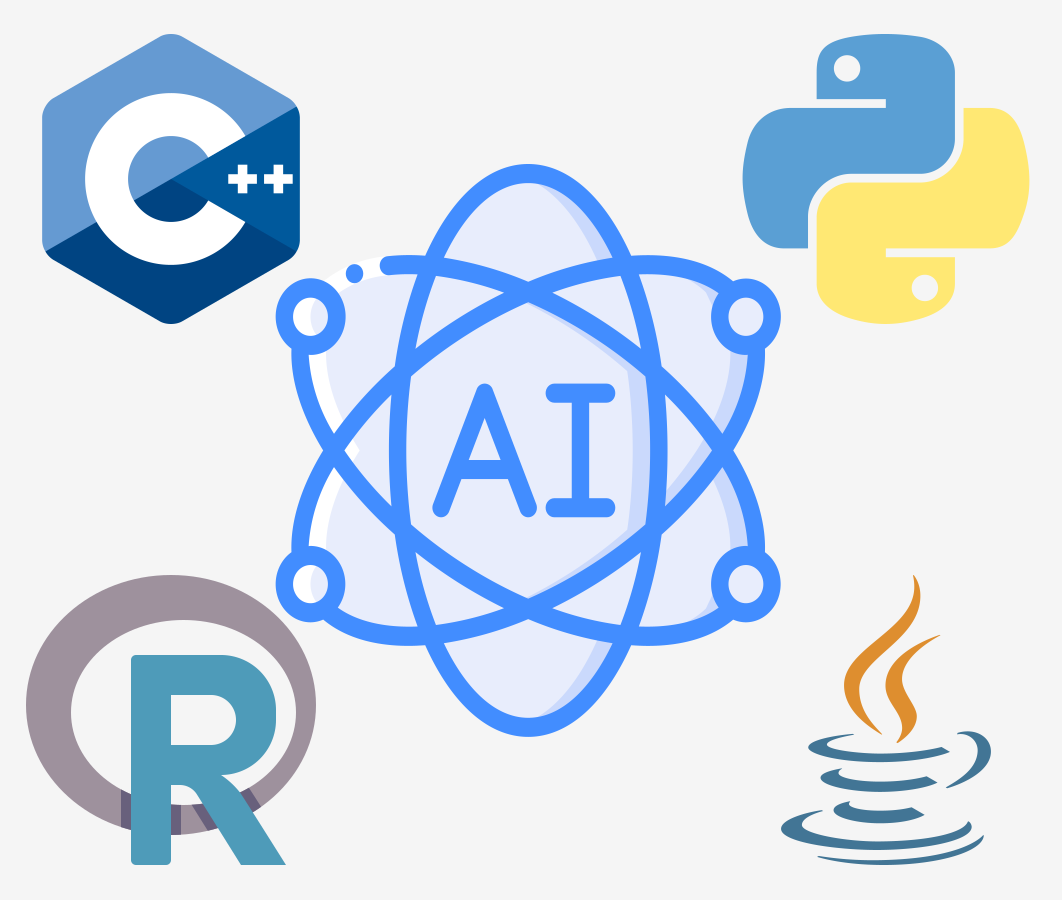
When it comes to AI development, there are many different OOP languages to choose from like C++, Java, Python and R. However, not all of these languages are created equal. Some are better suited for specific tasks than others. In this section, we will compare and contrast these different OOP languages for AI development, so that you can decide which one is right for you.
| OOP | PROS | CONS |
|---|---|---|
| Python |
|
|
| Java |
|
|
| C++ |
|
|
| R |
|
|
Strategies for Overcoming the Challenges of AI Development with OOP
There are many challenges that come with developing AI using object-oriented programming (OOP). However, there are also many strategies that can be used to overcome these challenges.
One challenge is that AI development using OOP can be very time consuming. This is because developers need to create and test a lot of different objects in order to get the AI to work properly. There are several strategies that can be used to speed up the development process. For example, developers can use object pools and pre-fabricated objects. Another strategy is to use design patterns. Design patterns can help developers create objects more quickly and efficiently.
Another challenge is that it can be difficult to debug AI programs written in OOP. It could be hard to track down the source of errors in complex object hierarchies.By using techniques such as object pools, design patterns, logging, and unit testing, developers can speed up the development process and reduce the amount of time spent debugging their code.
Conclusion
Artificial intelligence development in OOP is a complex process that requires special attention and care. From properly planning the architecture of your system to ensuring safety protocols are implemented, there are many aspects to consider. We hope that our tips have given you some insight into how you can better design and develop your own AI projects using OOP principles. With careful consideration and the right tools at hand, you too can create amazing applications with great potential for success.